Redefining AI Engineering: Insights from Hilary Mason on Building Products That Scale
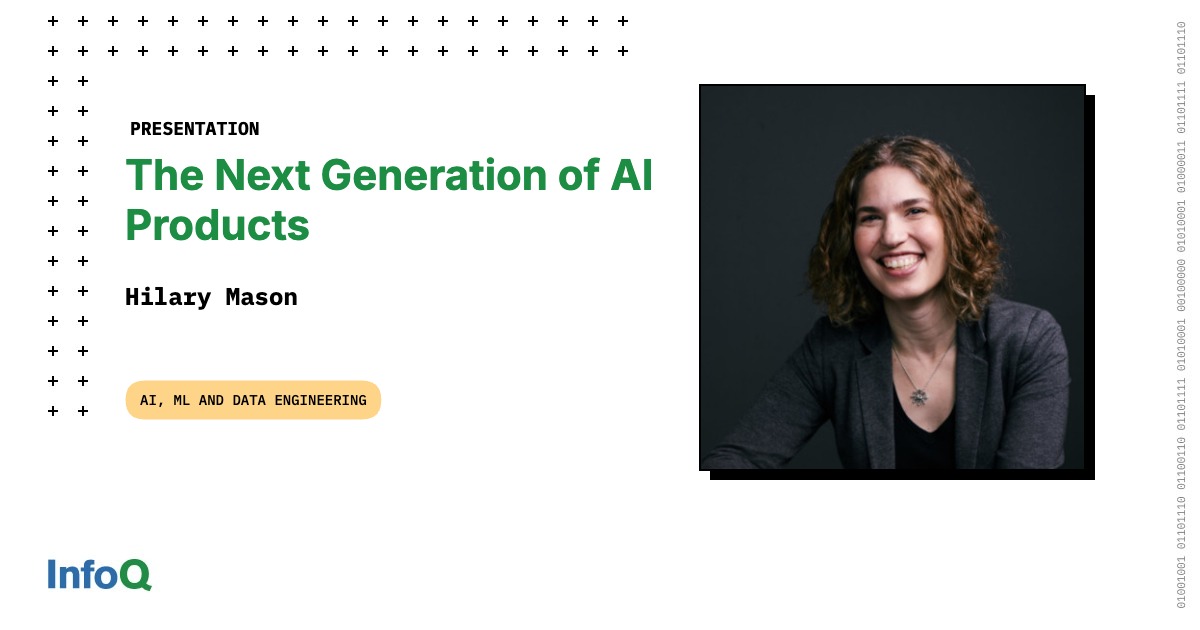
In her presentation on the next generation of AI products, Hilary Mason reflects on her path from academic research to leading large-scale AI product development. She highlights a fundamental shift from traditional discrete engineering to a probabilistic mindset, where uncertainty and iteration are the norm. Mason emphasizes that the hardest part of any AI stack isn't the algorithms or infrastructure, but the human considerations—designing for trust, ethics, and user experience. She also describes an “existential crisis” for engineers, urging them to move beyond pure code and embrace context management, systems thinking, and cultivated taste. This Q&A distills her core lessons.
1. What motivated Hilary Mason to move from academia to building AI products at scale?
Mason’s transition was driven by a desire to see her research have real-world impact. In academia, she enjoyed deep theoretical exploration, but she grew frustrated with the slow pace of deployment and the lack of feedback from actual users. The challenge of turning a probabilistic model into a reliable product that millions of people interact with every day fascinated her. She found that building AI at scale required not just algorithmic ingenuity but also robust engineering practices, cross-team collaboration, and a tolerance for failure. This shift forced her to think about how to make AI systems that are not only accurate but also useful, interpretable, and maintainable over time. Her journey illustrates that the hardest problems in AI today are not purely technical—they involve people, processes, and product design.

2. How does a probabilistic engineering mindset differ from traditional discrete engineering?
Traditional discrete engineering relies on deterministic rules and clear boundaries—every input maps to a known output. In contrast, probabilistic engineering embraces uncertainty. Mason explains that AI systems are inherently statistical: they produce probabilities, not certainties. This requires engineers to design for variability, implement monitoring for model drift, and build fallback mechanisms when predictions are unreliable. Instead of debugging a single line of code, teams must debug a model’s behavior across diverse data distributions. This shift also changes how success is measured: it’s not enough to be right 99% of the time; the 1% failure must be handled gracefully. Engineers must adopt a mindset of continuous learning and adaptation, treating the entire system as a living, evolving entity rather than a fixed artifact.
3. Why does Hilary Mason consider “human considerations” the hardest part of the AI stack?
Mason argues that human factors—like trust, fairness, privacy, and user expectations—are the most challenging because they lack simple mathematical solutions. An algorithm might produce accurate predictions, but if users don’t trust it, the product fails. Furthermore, ethical implications of AI decisions (e.g., bias in hiring algorithms) require constant attention. Managing these considerations involves cross-functional collaboration with designers, ethicists, legal teams, and product managers. It also means creating transparent feedback loops, so users can understand why a model made a recommendation. Mason notes that these “soft” aspects are often harder to scale than technical ones because they involve subjective judgments, regulatory constraints, and cultural differences. In short, human considerations force engineers to look beyond code and consider the broader societal context of their products.
4. What is the “existential crisis” for engineers in the age of AI?
According to Mason, many engineers feel a crisis of identity as AI becomes more autonomous. Traditional software development gave engineers a sense of control—every line of code directly influenced behavior. But with AI, models can learn patterns the engineer never explicitly programmed, leading to unpredictable outputs. This loss of deterministic control can be unsettling. Engineers worry: “If the model makes mistakes, am I responsible? Is my craft still valuable?” Mason argues that the crisis is actually an opportunity. As AI handles more routine coding tasks, engineers must evolve from writing every detail to becoming architects of intelligent systems. Their value shifts to defining the boundaries, setting objectives, and ensuring alignment with human values. The role becomes less about precise instructions and more about curating the context in which AI operates.
5. What does “great architecture” mean in modern AI product development?
Mason redefines great architecture not as a perfect blueprint, but as the ability to manage context, apply systems thinking, and exercise good taste. Context management means understanding when to use AI versus deterministic logic, how models interact with each other, and how data flows through the system. Systems thinking requires seeing the entire ecosystem—from data pipelines to user interfaces—as interconnected, so changes in one component affect others. Good taste, she says, comes from experience: knowing which patterns are sustainable, what trade‑offs are acceptable, and what simplicity looks like. An architect today must be comfortable with ambiguity and prioritize long‑term maintainability over short‑term hackery. The best architectures are those that allow teams to iterate quickly without creating technical debt, and that gracefully handle edge cases without breaking user trust.
6. How can engineers cultivate the “good taste” that Mason emphasizes?
Good taste, according to Mason, is not innate but cultivated through deep practice and reflection. Engineers can develop it by studying both successful and failed AI projects, reading diverse technical and design literature, and seeking feedback from mentors. It also involves a willingness to say “no” to overly complex solutions or trendy techniques that don’t fit the problem. Taste manifests in decisions like choosing a simpler model over a deep neural network if the data is limited, or investing in a high‑quality training dataset instead of chasing the latest algorithm. Mason recommends building a portfolio of small experiments to develop intuition about what works in practice. Ultimately, good taste is about judgment—knowing when to optimize for performance, when to prioritize interpretability, and how to balance innovation with reliability. It’s a skill that grows with experience and deliberate exposure to real‑world constraints.