How Spotify’s Multi-Agent System Revolutionizes Ad Delivery
Introduction
When Spotify Engineering set out to improve its advertising platform, the goal wasn’t simply to add another “AI feature.” Instead, the team aimed to solve a deep structural problem: how to balance user experience with advertiser ROI at massive scale. The result was a multi-agent architecture that orchestrates several specialized AI agents to handle different aspects of ad delivery. This approach has led to smarter, more efficient advertising that benefits both listeners and brands.
The Challenge: Scaling Personalized Ads Without Compromising Quality
Advertising on a platform like Spotify presents unique difficulties. Traditional systems rely on a single monolithic model to decide which ad to show when, but these models struggle with conflicting objectives. An ad must be relevant to the user, in a proper format (audio, video, or display), delivered at the optimal moment in a listening session, and priced competitively in real-time auctions. As Spotify’s user base grew past 300 million, the old approach became too slow and inflexible.
Structural Limitations of Monolithic Models
A single model often tries to optimize for several metrics simultaneously—click-through rate, completion rate, revenue, and user satisfaction—leading to trade-offs that hurt performance. For example, maximizing immediate revenue might push overly aggressive ads that annoy listeners. Additionally, updating one part of the model could inadvertently degrade another. The Spotify team needed a system where each component could be developed, tested, and scaled independently.
The Multi-Agent Solution: Specialized Collaboration
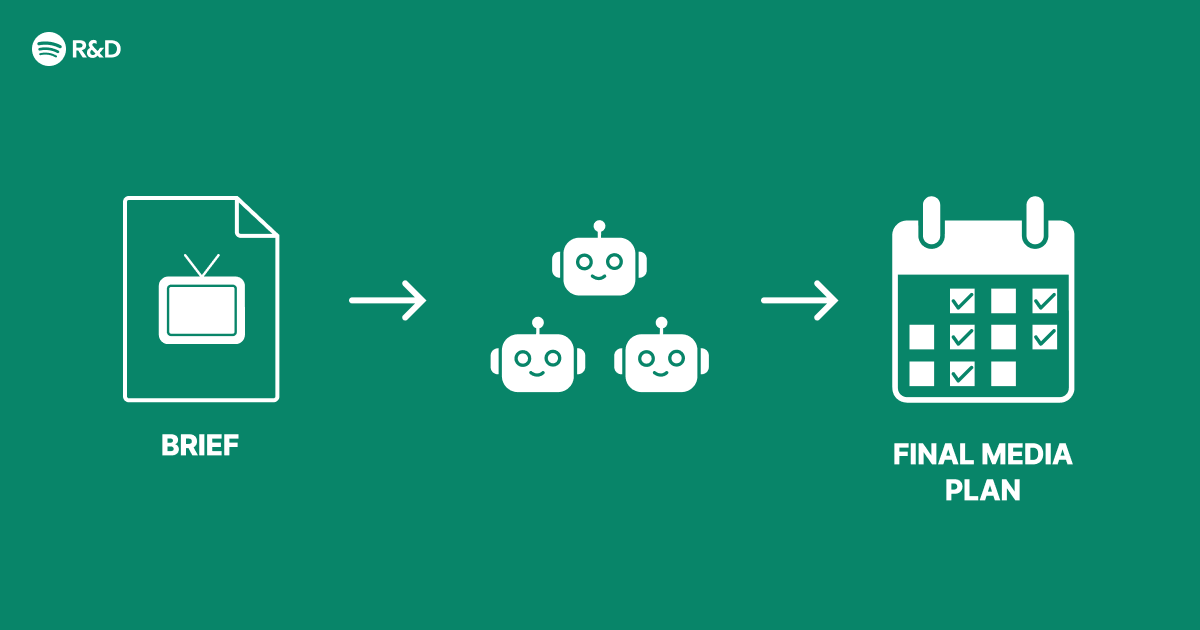
The architecture divides ad decision-making among multiple autonomous agents, each with a clear responsibility. They communicate through a shared context and a coordinator agent that handles conflicts and final decisions. This modular design enables faster iteration and better overall outcomes.
Key Agents in the System
- User Profiling Agent: Analyses real-time listening behavior, preferences, and contextual data (time of day, device, location) to build a nuanced user profile.
- Ad Selection Agent: Chooses candidate ads from the inventory based on the user profile and campaign targeting rules. It uses lightweight ranking models to narrow down thousands of possibilities to a handful.
- Format Optimization Agent: Determines the best ad format for the moment—audio spot, video takeover, or interactive overlay—by considering the user’s current activity (e.g., driving vs. browsing) and engagement history.
- Pricing & Auction Agent: Handles real-time bidding from advertisers, calculating the expected value of each impression and setting a floor price. It ensures fair competition and maximum revenue without overpricing.
- Exposure & Sentiment Agent: Tracks how often a user sees the same ad (frequency capping) and predicts how the ad might affect user satisfaction. This agent can veto placements that risk annoyance.
Coordination Layer
A Coordinator Agent receives proposals from all specialized agents and reconciles conflicting signals. For instance, if the Format Optimization Agent suggests a video ad but the User Profiling Agent indicates the user is likely to skip video, the coordinator may switch to an audio ad with higher completion probability. The coordinator logs decisions for offline analysis and learning.
Benefits Realized
Since deploying the multi-agent system, Spotify has observed several measurable improvements:
- Higher Ad Relevance: Users see ads that align better with their music taste and listening context, leading to better engagement without feeling intrusive.
- Improved Fill Rates: The system can dynamically select ad formats, reducing situations where no suitable ad is available, especially in premium inventory.
- Faster Model Iteration: Teams can update individual agents (e.g., the Pricing Agent) without retraining the entire stack. Experimentation cycles shortened from weeks to days.
- User Retention: By incorporating the Sentiment Agent, the platform reduced ad fatigue and negative feedback, contributing to stable user retention even as ad load increased.
Under the Hood: Communication and Learning
Agents communicate via a lightweight message bus that passes structured data like “user_embedding: [float128], proposed_ads: [list], suggested_format: ‘audio’.” Critically, agents do not share raw user data; each agent only sees anonymized features required for its task. This design supports privacy compliance.

Each agent operates a neural network or a gradient‑boosted tree trained on specific objectives. The Coordinator uses a simple meta‑model that learns from past successful placements to balance proposals. Multi‑agent reinforcement learning was considered but proved too complex initially; the team opted for a supervised‑learning base with online bandit exploration.
Continuous Improvement
The architecture includes a feedback loop: after every ad impression, all agents receive outcome signals (completion, click, skip, sentiment score). They update their models incrementally. This online learning allows the system to adapt to shifting user behavior and advertiser campaigns within hours.
Internal Anchor Links for Easy Navigation
Readers can jump straight to sections of interest:
- Structural Limitations of Monolithic Models
- The Multi-Agent Solution
- Benefits Realized
- Under the Hood: Communication and Learning
Conclusion: A Blueprint for Smart Advertising
Spotify’s multi‑agent architecture proves that breaking apart a complex problem into specialized, collaborative agents can yield superior results compared to a giant monolithic model. The system’s flexibility allows it to evolve with changing user expectations and advertising technologies. While the approach required significant investment in infrastructure and coordination logic, the payoff in efficiency, scalability, and user satisfaction has made it a core part of Spotify’s engineering strategy. As streaming continues to grow, such architectures may become the standard for any platform that must balance personalization with revenue goals.