7 Key Shifts in Intrusion Detection: From Signatures to Autonomous Agents
Intrusion detection has long relied on static signature databases, but the rise of machine learning and autonomous agents is rewriting the rules. The question is no longer just "Does this match a known pattern?" but "Does this actually make sense in context?" This article explores seven fundamental shifts in how sensors think, from SnortML's adaptive models to agentic AI that hunts threats proactively. Each change redefines the architecture, making detection smarter, faster, and more resilient against zero-day attacks.
1. From Static Signatures to Dynamic Behavior Models
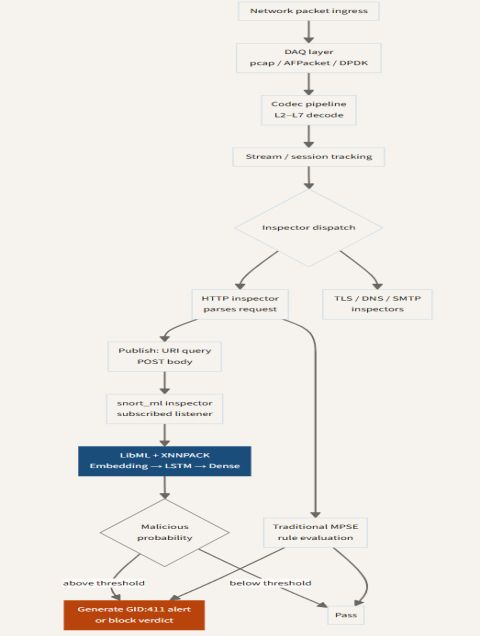
Traditional signature-based systems compare incoming traffic against a fixed database of known attack patterns. This approach works well for known threats but fails against novel or polymorphic attacks. Modern intrusion detection shifts to behavioral baselines, where machine models learn what "normal" looks like for network traffic or system calls. Instead of matching a string or byte sequence, the sensor asks: Does this deviate from the established profile? SnortML, for example, uses supervised learning to build behavior profiles, triggering alerts only when deviation exceeds a confidence threshold. This reduces false positives and catches zero-day exploits that signatures would miss.
2. The Rise of Contextual Awareness
A packet arriving at 3 AM from an unknown IP is suspicious—but what if it's a scheduled backup? Context matters. Agentic AI systems embed contextual reasoning into detection: time of day, user role, asset criticality, historical patterns. Instead of firing an alert for every anomaly, the sensor weighs evidence against the current environment. This shift from a one-size-fits-all rule set to a context-aware model cuts through noise and prioritizes true threats. For instance, an SSH login attempt from a remote admin might be allowed if it's consistent with the admin's travel schedule, but blocked if it happens during a known attack window.
3. Autonomous Agents Replace Static Rules
Where traditional IDS follows predetermined logic (IF packet contains X THEN alert), agentic AI introduces autonomous agents that can explore, hypothesize, and act. These agents don't wait for a rule to fire; they proactively hunt for suspicious behavior, correlate events across time, and even initiate countermeasures such as isolating a compromised host. The architecture becomes distributed—each agent operates independently yet coordinates with peers. This paradigm is a fundamental break from the monolithic sensor, enabling detection to scale across hybrid environments without central bottlenecks.
4. Continuous Learning Replaces Manual Updates
Signature updates required human analysis of new malware strains, a slow and reactive process. Machine learning models within SnortML and similar frameworks update their understanding continuously from live data. As attacks evolve, the model adjusts its internal parameters—no manual signatures needed. This closed-loop learning means the sensor improves over time, even adapting to subtle changes in the environment. However, it also introduces challenges: models can drift, become poisoned by adversarial inputs, or learn biased behaviors. Hence, careful monitoring of the learning process itself becomes critical.
5. From Alert Floods to Intelligent Prioritization
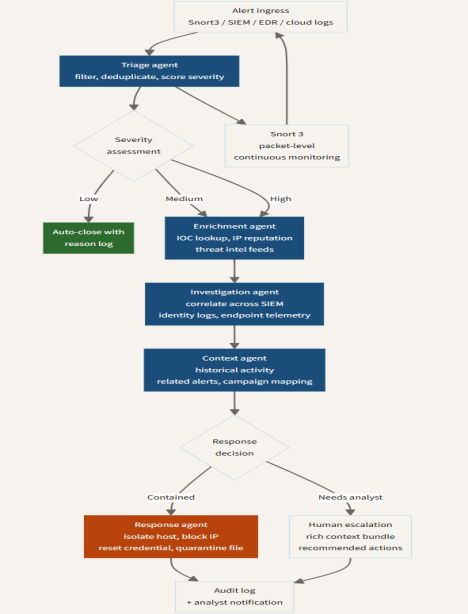
Legacy IDS often drown analysts in alerts, most of which are false positives. The new architecture uses probabilistic scoring and risk assessment to rank threats. Instead of a flat list, each alert is tagged with a confidence score and a recommended action. Agentic AI can automatically triage—investigate low-confidence events, escalate medium ones, and block high-confidence attacks in real time. This shift dramatically reduces analyst fatigue and response time. The result: security teams focus on the few incidents that matter, rather than sifting through thousands of logs.
6. Distributed Intelligence Over Centralized Processing
Older models funnel all data to a central server for analysis, creating a bottleneck and single point of failure. Modern intrusion detection pushes intelligence to the edge: sensors at each endpoint, network segment, or cloud workload run local ML models that can make decisions instantly. They share only summarized insights or high-priority alerts with a central orchestrator. This distributed architecture reduces latency, handles bandwidth constraints, and maintains operation even if connectivity is lost. SnortML can operate in such a fashion when paired with agentic management, enabling autonomous response at the source.
7. The Emergence of Self-Healing Networks
The ultimate evolution is a detection architecture that not only identifies threats but autonomously recovers from them. By combining SnortML's anomaly detection with agentic AI's decision-making, networks can reconfigure themselves on the fly—blocking ports, rerouting traffic, spinning up clean containers—without human intervention. This self-healing ability shortens the dwell time of attackers and limits blast radius. While full autonomy is still emerging, early implementations show promise in containing ransomware and APT breakouts before they cause major damage.
The journey from signature-based detection to context-aware, agentic AI is not just a technological upgrade—it's a philosophical shift. Sensors no longer just react; they reason. As SnortML and agentic systems mature, the future of intrusion detection lies in autonomous, adaptive defenses that think before they act. Embracing this evolving architecture is essential for staying ahead of adversaries who are equally leveraging AI. The next wave of security will be defined not by the size of your signature database, but by the intelligence of your sensors.