Mapping the Invisible: James Webb Reveals the Universe's Hidden Skeleton
For decades, astronomers have theorized about an immense, hidden structure that weaves through the cosmos, connecting galaxies like beads on a necklace. Now, the James Webb Space Telescope (JWST) has delivered the sharpest and most detailed map yet of this so-called cosmic web, revealing a vast network of gas and dark matter stretching across billions of light-years. By analyzing data from the massive COSMOS-Web survey, which captured over 164,000 galaxies, researchers traced this cosmic architecture back to when the universe was just a billion years old—a time when galaxies were still in their infancy. This breakthrough not only confirms long-standing models but also provides new clues about how galaxies form and evolve within the web's invisible filaments.
What exactly is the cosmic web?
The cosmic web is the large-scale structure of the universe—a sprawling, three-dimensional network of dark matter, gas, and galaxies. Think of it as the skeleton of the cosmos: long, threadlike filaments of material intersect at dense nodes (where galaxy clusters reside), while vast empty voids separate them. This structure arose from tiny density fluctuations in the early universe, amplified by gravity over 13.8 billion years. Until recently, astronomers could only glimpse small patches of it, but JWST's infrared vision now peers deeper and sharper than ever, revealing the web's faintest strands. These filaments funnel gas into galaxies, feeding their growth and shaping their evolution. Without this hidden network, galaxies would be isolated islands; instead, they are connected in a cosmic dance across unimaginable distances.
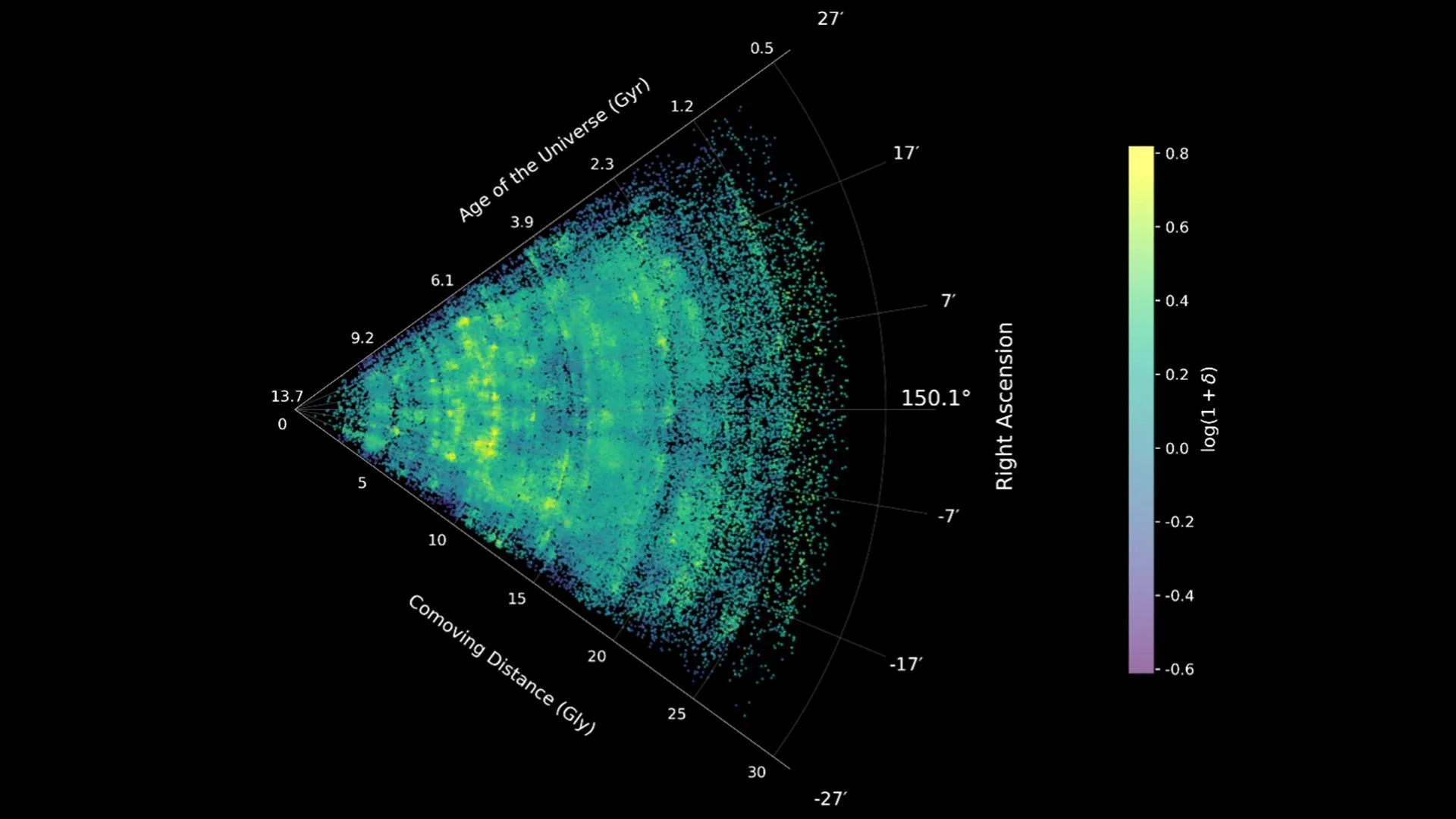
How did JWST create the clearest map of the cosmic web?
The map emerged from the COSMOS-Web survey, a massive observational campaign that used JWST's Near-Infrared Camera (NIRCam) and Mid-Infrared Instrument (MIRI) to survey a patch of sky roughly the size of three full moons. By collecting light from over 164,000 galaxies, the team could trace the distribution of matter—both luminous and dark—across immense distances. The key was analyzing the gravitational lensing effect, where the web's gravity slightly warps the light from background galaxies. This allowed researchers to map the web's filaments even where no stars or gas shine. Previous maps from the Hubble Space Telescope or ground-based observatories were blurrier; JWST's superior resolution and sensitivity revealed the fine threads and knots of the web in unprecedented detail, confirming theoretical predictions and providing the sharpest picture of cosmic structure to date.
What is the COSMOS-Web survey and why is it important?
COSMOS-Web is one of the largest JWST surveys approved for the telescope's first few years of operation. It focuses on the Cosmic Evolution Survey (COSMOS) field, a well-studied region covering about 0.6 square degrees of sky. The survey's goal is to map the universe's large-scale structure and study galaxy formation across cosmic time. By targeting a single, deep field, COSMOS-Web allows astronomers to see a continuous slice of the universe from the present day back to when it was only about 500 million years old. For the cosmic web map, the team used data from the survey's initial observations, covering roughly 55% of the total field. The survey's legacy will include a three-dimensional catalog of galaxies and dark matter, enabling studies of how environment influences galaxy evolution—from star formation to supermassive black hole activity.
How many galaxies were analyzed to create this map?
The map was built from more than 164,000 galaxies captured in the COSMOS-Web survey's first-year data. These galaxies span a wide range of distances, corresponding to different eras of cosmic history. By measuring their positions and redshifts (thanks to JWST's spectroscopy), the team could place them in a three-dimensional framework. The sheer number of sources enables statistical mapping—individual galaxies are like dots that, when averaged over, reveal the underlying filamentary structure. This contrasts with earlier maps that used far fewer galaxies, often limited by the sensitivity of previous telescopes. With JWST, even the faintest, most distant galaxies (some over 13 billion light-years away) become visible, providing a much denser and more accurate tracer of the cosmic web's shape.
How far back in time does this map reach?
The map traces the cosmic web back to when the universe was only about 1 billion years old—a mere 7% of its current age. This is a critical epoch known as the Epoch of Reionization's tail, when the first stars and galaxies were assembling. At that time, the cosmic web was still forming: filaments were less defined, and the nodes (cluster precursors) were smaller and less massive. By comparing the web at this early era to later snapshots, astronomers can see how structure grew over time. JWST's infrared sensitivity is essential because light from these remote galaxies is stretched into longer wavelengths due to the universe's expansion. Before JWST, maps from Hubble could only reach back to about 2–3 billion years after the Big Bang; this new map pushes nearly 2 billion years earlier, offering an unprecedented view of the universe's adolescence.
What makes this map the clearest ever produced?
The clarity stems from two key advantages of JWST: resolution and sensitivity. First, JWST's 6.5-meter mirror and advanced optics provide sharper images than Hubble at similar infrared wavelengths. This means finer details—thin filaments and small knots—are no longer blurred together. Second, JWST can detect fainter objects, which increases the density of galaxies used as tracers. With 164,000 galaxies, the map has a much higher signal-to-noise ratio than previous surveys. Additionally, the team used sophisticated algorithms to subtract foreground light and correct for gravitational lensing distortions. The result is a map where the web's delicate threads stand out clearly against the background, rather than appearing as vague smudges. This clarity allows astronomers to test models of dark matter behavior and galaxy formation with unprecedented precision.
What does this new map tell us about galaxy formation?
The map reveals that the cosmic web is not merely a passive backdrop—it actively shapes galaxy evolution. Filaments channel cold gas into galaxies, fueling star formation. The map shows that galaxies located in denser regions (nodes) tend to have evolved differently from those in sparser filaments. Specifically, the high-resolution map confirms that galaxies in filaments exhibit more elongated shapes and higher rates of star formation compared to their isolated counterparts. It also provides the first direct evidence that the web's structure was already in place just 1 billion years after the Big Bang, implying that galaxy formation was already being guided by dark matter filaments at that early time. This matches simulations but had not been observed so clearly. Additionally, the map hints at feedback mechanisms: active galactic nuclei (AGN) may blow gas out of galaxies, disrupting the web locally—a detail visible only in such a sharp map. Future analysis will link these threads to individual galaxy properties.
What are the next steps for this research?
The team plans to extend the map to the full COSMOS-Web field—currently only 55% has been analyzed for this map. With the complete survey covering ~0.6 square degrees, the map will include many more galaxies and reveal larger-scale filaments. They also aim to combine JWST data with ALMA (radio) and Chandra (X-ray) observations to see how the web interacts with different components: cold gas, hot plasma, and dark matter. High-resolution simulations will be compared pixel-by-pixel with the map to refine models of cosmic structure formation. Another priority is to study the Epoch of Reionization (300–500 million years after the Big Bang) by pushing the map even deeper. Ultimately, the COSMOS-Web collaboration intends to release a public data product, enabling astronomers worldwide to explore the cosmic web's influence on galaxy evolution across cosmic time.