SpaceX and NASA Launch 34th Resupply Mission to the International Space Station
Mission Overview
NASA and SpaceX are preparing to send the 34th commercial resupply mission to the International Space Station (ISS). The launch, targeted for mid-May, will see a SpaceX Falcon 9 rocket carrying the Dragon spacecraft from Launch Complex 40 at Cape Canaveral Space Force Station in Florida. The Dragon is loaded with approximately 6,500 pounds of scientific investigations, supplies, and equipment for the orbiting laboratory.
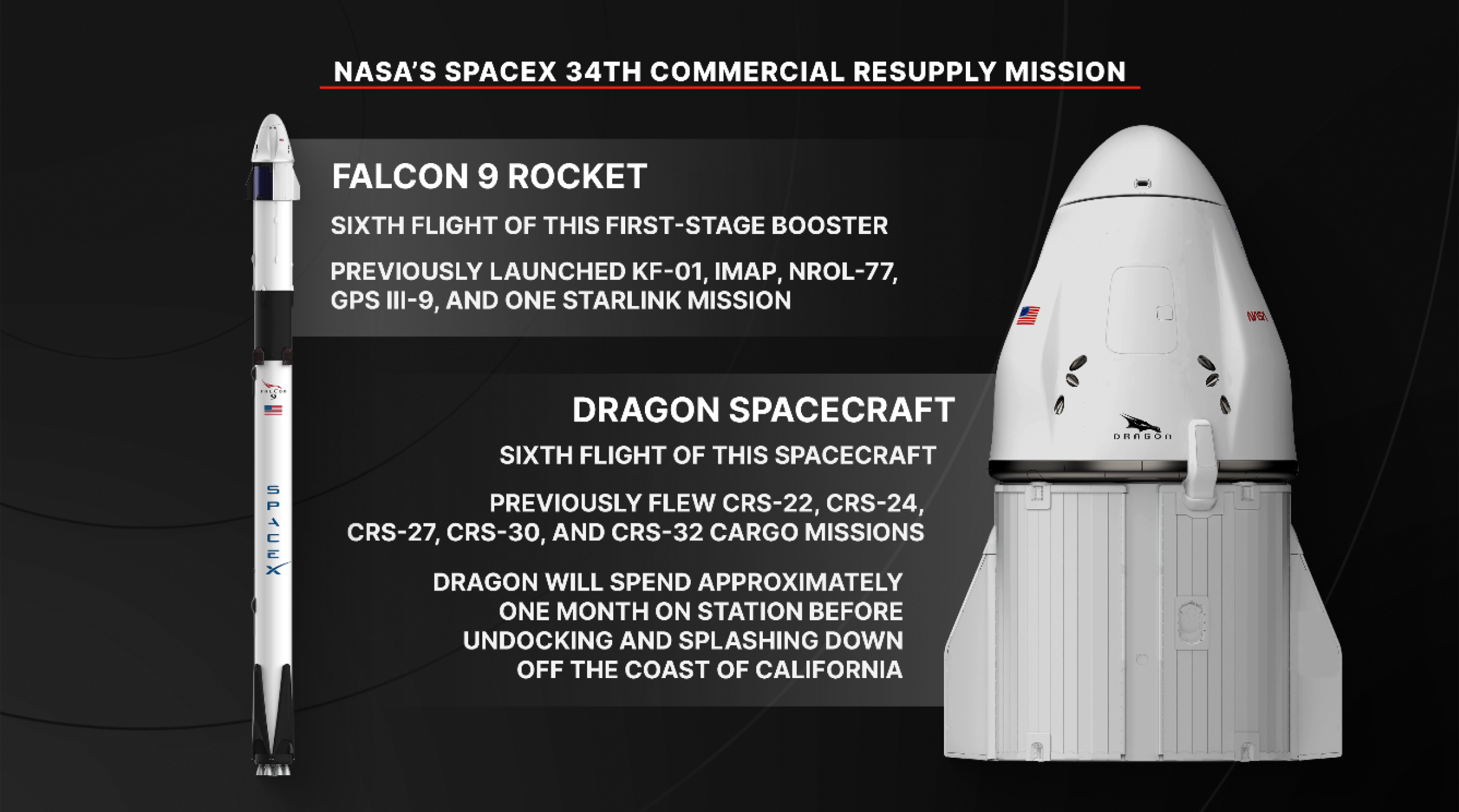
Upon reaching the ISS, the Dragon will autonomously dock to the forward port of the station's Harmony module. The mission supports the continuous human presence in space, enabling research that benefits life on Earth and prepares humans for longer journeys to the Moon and Mars as part of NASA's Artemis program and beyond.
Coverage of the launch and arrival can be viewed on NASA+, Amazon Prime, and NASA's YouTube channel. Viewers can also follow updates via NASA's social media platforms.
Science Highlights
For over 25 years, the ISS has hosted more than 4,000 experiments from scientists in over 110 countries, leveraging microgravity to conduct research impossible on Earth. This mission delivers several new experiments that will advance our understanding of space phenomena and Earth's own environment.
ODYSSEY: Testing Earth-Based Microgravity Simulators
The ODYSSEY experiment aims to evaluate the fidelity of Earth-based microgravity simulators. By comparing bacterial behavior in actual spaceflight with results obtained from simulators on the ground, researchers can determine how well these simulators replicate true space conditions. This knowledge is crucial for designing experiments that rely on simulated microgravity before committing to expensive launches.
STORIE: Monitoring Space Weather
The STORIE instrument will monitor charged particles in low-Earth orbit. These particles are responsive to space weather events, which can disrupt power grids, satellite communications, and other technological assets. By collecting real-time data, STORIE could help scientists develop more accurate prediction models and response strategies to mitigate the impact of space weather on Earth and orbiting infrastructure.
Laplace: Understanding Dust Particle Dynamics
The Laplace experiment investigates the movement and collision of dust particles in microgravity. This research provides insights into planetary formation—including Earth's origins—and adds fundamental understanding of particle behavior in our solar system and beyond. Such knowledge is essential for future exploration missions that may encounter dusty environments on the Moon, Mars, or asteroids.
These experiments, along with routine supplies and crew support, underscore the continuing importance of the ISS as a platform for scientific discovery and technological innovation. To learn more about this mission and previous ones, explore the mission overview or dive into each science highlight.